
You recognise the question. You remember seeing the method. But when you have to answer without help, you cannot decide what to do first.
That is a useful signal. Your next revision session needs to reveal where understanding breaks down, then give you a chance to repair it.
For GCSE and IGCSE Maths and Chemistry, a practical approach is to choose one topic, try a question independently, check your reasoning, fix the mistake and return to a similar question after a gap. Use your own exam board, qualification and tier to check what you need to cover.
Why reading notes can feel more productive than it is
A worked solution gives you the next step before you have to choose it. Following that solution and producing the method independently are different tasks.
Reading is useful when you are learning or clarifying an idea. After that, close the explanation and see what you can retrieve or do yourself. Research reviewed by the Education Endowment Foundation supports retrieval practice as a useful learning approach, while also highlighting that successful classroom application depends on context. It is a reason to build opportunities to recall and apply knowledge, rather than a promise that one technique will work equally well for every topic. Read the EEF evidence review.
If a concept is new, begin with teaching and a suitable worked example. Repeatedly guessing at something you have not learned is unlikely to tell you how to improve.
Try this 30-minute revision session
This is an example structure, not a required daily duration. Adjust it to the topic, your workload and the support you need.
| Time | What to do | What it helps you notice |
|---|---|---|
| 3 minutes | Recall the key idea without notes. | What can you explain or remember independently? |
| 7 minutes | Study a worked example and explain each step. | Why is this method appropriate? |
| 12 minutes | Answer a small set of related questions. | Can you choose and use the method yourself? |
| 5 minutes | Check, correct and explain mistakes. | What caused the error? |
| 3 minutes | Choose a follow-up question and plan a revisit. | What will you check next time? |
Write working on paper, even when practising multiple-choice questions. A correct option is more useful evidence when you can explain why it is correct and why the alternatives are not.
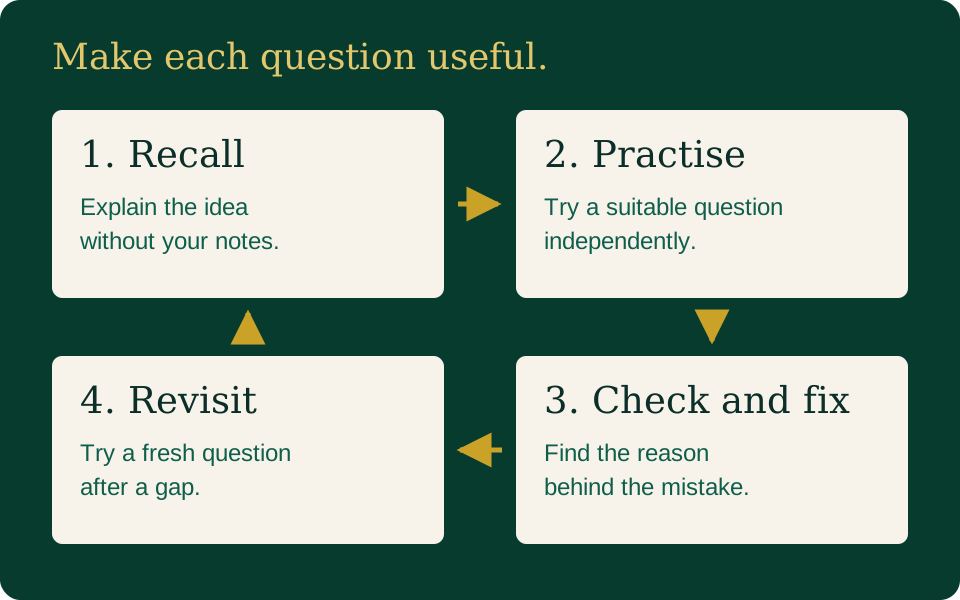
View the revision cycle at full size.
Maths example: why adding the discount back does not work
Question: A jacket costs AED 68 after a 15% discount. What was the original price?
A tempting approach is to add 15% of 68. That gives AED 78.20, but it uses the reduced price as the percentage base.
After a 15% discount, the customer pays 85% of the original price. If the original price is x:
- 0.85 × x = 68
- x = 68 ÷ 0.85
- x = AED 80
Check it: 15% of 80 is 12, and 80 − 12 = 68.
Your mistake-log entry should name the decision that went wrong: “I treated a percentage of the new amount as a percentage of the original amount.” That is more useful than writing “careless mistake.”
For a follow-up, change the situation: a bill becomes AED 126 after a 5% increase. Divide by 1.05 to recover the original amount, which is AED 120. The method changes with the relationship described, so read the question before choosing the operation.
Explore Maths revision and practice questions.
Chemistry example: connect the calculation to the particles
Question: How many moles are present in 4.8 g of magnesium? Use Ar(Mg) = 24.
Use the relationship:
amount in moles = mass ÷ molar mass
For magnesium, the molar mass is 24 g mol⁻¹:
n = 4.8 ÷ 24 = 0.20 mol
Check the scale: 4.8 g is one fifth of 24 g, so the amount should be one fifth of a mole.
Now connect it to an equation:
Mg + 2HCl → MgCl₂ + H₂
The equation gives a mole ratio of 1 Mg : 2 HCl. Therefore, 0.20 mol of Mg reacts with 0.40 mol of HCl, assuming the reaction proceeds as shown and sufficient acid is available.
If you can calculate 0.20 mol but cannot use the equation ratio, those are two different learning needs. Record which step you could complete and where you became stuck. Copying the whole solution will hide that distinction.
Explore Chemistry revision and practice questions.
Make a mistake log you will actually use
Keep it short enough to revisit. For each useful error, record:
- The topic and question: enough detail to find it again.
- The reason: missing knowledge, unsuitable method, misread information, calculation or units.
- The corrected idea: one sentence explaining the fix.
- A fresh check: a related question to try later without looking at the answer.
Revisiting material across separate sessions is a way to build spacing into your plan. For example, correct a question today, try a similar one two days later, and check again the following week. Those gaps are an example, not a universal schedule. If the later question is still inaccessible, revisit the explanation or ask for help before adding more questions.
When should you use past papers?
Topic questions help you isolate a particular gap. A paper or mixed set asks you to recognise which knowledge and method to use without a topic heading giving it away.
Use both. As your understanding develops, include practice with your actual board and paper format. Cambridge explains that past papers help students become familiar with assessment requirements and command words. See Cambridge’s learning and revision guidance.
For written questions, compare your response with the relevant mark scheme. Check your working, units, scientific vocabulary and whether you answered the command word. Multiple-choice practice supports this preparation, but it does not replace writing full solutions, explaining ideas or practising the assessment formats your course requires.
Supporting a child with revision?
If you are reading as a parent, the companion guide Why Your Child Studies but Still Loses Marks explains how to review marked work and discuss the next useful step without doing the revision for them.
Common revision questions
How long should I revise each day?
There is no single duration that suits every student. Start with a realistic session and a specific task, then check what you can do afterwards. Adjust your schedule across subjects rather than measuring success only by time at a desk.
Can I use questions from a different exam board?
Shared-topic questions can help you practise underlying ideas. Check the content, tier, notation, calculator rules and assessment format against your own course before treating another board’s paper as a complete match.
Does a good multiple-choice score mean I am ready for the exam?
It is one piece of evidence. Also check whether you can show working, explain reasoning and answer written questions under the conditions your actual paper requires. A short practice result is not a predicted GCSE or IGCSE grade.
Choose one topic and start there
You do not need a perfect revision plan before you begin. Choose one topic, attempt a few suitable questions and use the results to decide your next step.
Try The Study Lab’s free exam practice tool. You can explore Maths and Chemistry practice and use feedback to identify areas for another look.
If you would like support turning those findings into a learning plan, explore the 12-week programme or request a consultation. We can discuss the gaps, the teaching your child needs and how to check progress along the way.
About Messoud Djaider
Messoud is the founder of The Study Lab, a British teacher and chemical engineer offering online GCSE and IGCSE Maths and Chemistry tuition for students in the UAE, across the GCC and internationally.
Follow The Study Lab for more subject explanations and revision guidance.