
The books are open. Your child is spending time revising. They can tell you which topic they studied yesterday. Then a test comes back, and the result looks much the same.
It is understandable to feel concerned. Before adding more revision hours or another set of worksheets, take a closer look at the work. Time spent studying and the ability to answer independently are different things.
A useful first question is: where, exactly, are the marks being lost? The answer can point towards a better explanation, a different kind of practice or more focused teacher support.

Start with the marked work, not the headline score
A total score tells you the outcome of a particular assessment. It does not, by itself, explain the cause.
Two papers can cover different topics and demand different levels of reasoning. If you are comparing results, ask whether the assessments were comparable and what the teacher has noticed across them. A lower mark on a more demanding paper is not automatically evidence that your child knows less.
Look at a small sample of marked questions together. You might choose one they answered well, one they nearly completed, one they could not start and one that surprised them. This is a practical conversation starter, not a diagnostic test.
Ask your child to explain their thinking before showing them the solution. The explanation often tells you more than whether they remember the final answer.
Five places where revision can break down
These are possibilities to investigate with your child and teacher, rather than labels to assign from one answer.
| What you notice | What to explore | A useful next step |
|---|---|---|
| They recognise a solution but cannot begin alone. | Were they following the method, or choosing it themselves? | Study one explained example, then try a similar question without it. |
| They apply a familiar rule in the wrong situation. | Do they understand when the rule applies? | Compare two question types and explain why their methods differ. |
| They complete early steps but get stuck later. | Is a prerequisite or connection missing? | Locate the first uncertain step and practise that skill. |
| They lose marks through units, wording or missing explanation. | Did their response meet the question’s requirements? | Use the marked response to build a short checking routine. |
| They cannot answer questions on particular content. | Has the content been taught and understood? | Clarify course coverage with the teacher before treating it as forgotten work. |
The distinction matters. A child who has not learned a topic needs teaching. A child who understands the topic but chooses an unsuitable method needs practice making that decision. Giving both children the same extra worksheet may miss the real need.
Maths: find the first decision that went wrong
Consider this illustrative answer:
Simplify 4a + 3b − a.
A student writes 6ab. The useful correction is more than “the answer is 3a + 3b.”
The student may be treating every term as something that can be combined. Ask them to identify the like terms: 4a and −a combine to make 3a; the 3b remains separate. The expression contains addition and subtraction, so the letters are not simply multiplied together.
Now use a fresh check, such as 5x + 2y − 2x. Can the student explain why the result is 3x + 2y?
If they can repeat the explanation but still struggle on another expression, ask their teacher what example or representation would make the distinction clearer. You do not need to become the Maths teacher yourself. Your role is to help make the question specific enough to get useful support.
Chemistry: knowing the answer is different from explaining it
A student might correctly state that molten sodium chloride conducts electricity, but then write that this is because its electrons are free to move.
The key idea for molten sodium chloride is mobile ions carrying charge. In solid sodium chloride, the ions are held in fixed positions and cannot move through the structure. Simply memorising “molten conducts, solid does not” can leave the explanation incomplete.
A useful follow-up is: “What are the charged particles, and can they move?” Then compare the answer with a metal, where mobile electrons account for electrical conduction.
This separates two tasks: recalling an observation and explaining it using an appropriate model. When reviewing Chemistry work, check which task the question actually asked for.
Explore Chemistry revision and practice questions.
Replace “Have you revised?” with a more useful conversation
Try a few specific questions:
- “Which question could you answer without help?”
- “Where did you become unsure?”
- “What did the feedback help you change?”
- “How will you check whether that idea makes sense next time?”
These questions encourage planning, monitoring and evaluating learning. The Education Endowment Foundation identifies these as central elements of metacognition and self-regulation, and emphasises teaching and modelling specific strategies. That does not mean a child should already know how to organise all their revision independently. Read the EEF guidance on metacognition.
You can support a workable routine, help your child find the right materials and encourage them to take a precise question to their teacher. EEF guidance also notes that, particularly at secondary level, helping pupils manage their learning may be more valuable than parents directly trying to teach homework content. Read the parental engagement guidance.
What should you track between school tests?
Keep the evidence small and specific. A simple review note could contain:
- The skill: for example, combining like terms or explaining ionic conduction.
- The starting difficulty: the first point where your child needed help.
- The support used: an explanation, model, worked example or targeted question set.
- The independent check: a fresh question completed after a gap.
- The next step: continue practising, move to an application or ask for clarification.
A successful repeat of yesterday’s exact question can reflect memory of that answer. A fresh question on the same underlying idea offers a different check. Neither one small result nor a short multiple-choice assessment should be turned into a confident exam-grade prediction.
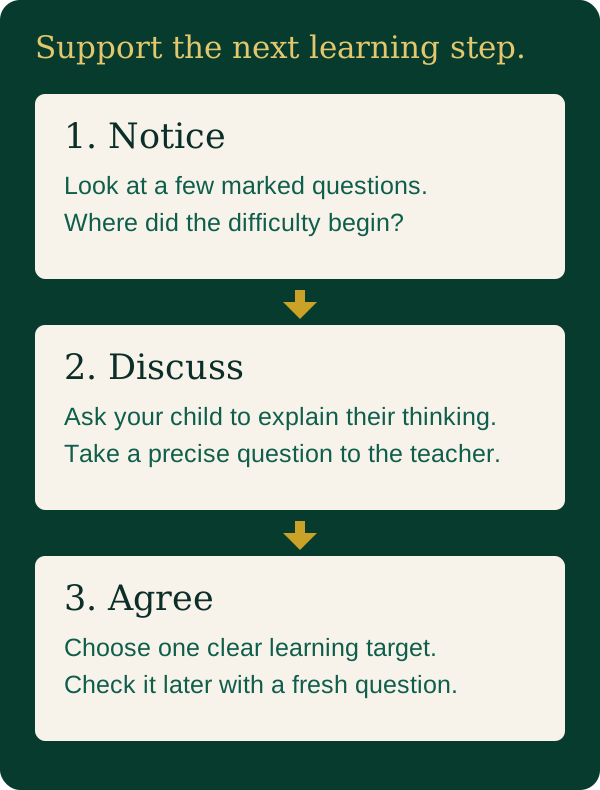
View the parent support graphic at full size.
When is it time to ask for extra help?
Speak to the class teacher when the same misunderstanding keeps appearing, when your child cannot explain where to begin or when you are unsure what content their course requires.
Useful questions for a teacher or tutor include:
- Which prerequisite skills are limiting progress?
- Can you show us an example of what a complete answer needs?
- What should our child practise first, and what should wait?
- How will we check that the teaching has helped?
Extra tuition is most useful when its purpose is clear. Ask how the tutor will identify gaps, teach the missing ideas and review independent work. More hours alone do not explain what will change in those hours.
For a practical session structure your child can use, see How to Revise GCSE & IGCSE Maths and Chemistry.
How The Study Lab can help you choose a starting point
The Study Lab’s 12-week programme starts with assessment and planning, followed by teaching and practice focused on identified needs. Exam-question work and progress checks help inform what to revisit next.
The purpose is to agree suitable priorities and monitor learning, rather than promise that every gap will disappear within a fixed time. The right plan depends on your child’s current understanding, course coverage and goals.
You can explore the 12-week programme or request a consultation to discuss what you are seeing in your child’s work.
If you would like an initial practice snapshot, try the free exam practice tool. It can give you topics to discuss; it does not replace teacher review or predict an exam grade.
Questions parents often ask
Should my child revise for longer if their marks are not improving?
First check what is happening during the existing revision time. If a misconception or missing prerequisite is causing repeated errors, a better explanation and focused practice may be more useful than extending the same activity.
Should we switch exam boards to find easier practice questions?
Start by confirming the qualification, tier and content your child is studying. Questions from another board may practise shared ideas, but their content and assessment requirements may differ. Ask the teacher which resources are suitable.
Does one disappointing mock result mean my child cannot reach their goal?
One result cannot settle that question. Review the marked work, the remaining content and the time available with the teacher. Set priorities from that evidence and check progress on suitable tasks, rather than drawing a conclusion from the total alone.
About Messoud Djaider
Messoud is the founder of The Study Lab, a British teacher and chemical engineer offering online GCSE and IGCSE Maths and Chemistry tuition for students in the UAE, across the GCC and internationally.
Follow The Study Lab for more subject explanations and revision guidance.